
BS Civil Engineering
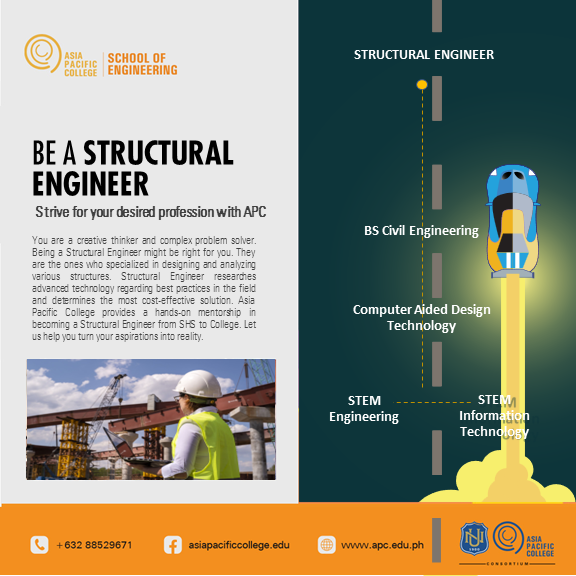
The Bachelor of Science in Civil Engineering (BS CE) program is designed to develop competent, industry-ready, and licensure-prepared civil engineering graduates. The program provides intensive training in core civil engineering disciplines, specialization courses, and thesis development. Its final academic year focuses on professional preparation through a 6-month intensive internship and review for the Civil Engineering Licensure Examination..
APC offers five Civil Engineering specializations which the students can choose from after familiarizing themselves with their majors and before entering their third year. The specializations offered are the following:
- Construction Management Engineering (BSCE-CME)
- Geotechnical Engineering (BSCE-GTE)
- Structural Engineering (BSCE-STE)
- Transportation Engineering (BSCE-TPE)
- Water Resources Engineering (BSCE-WRE)
Civil Engineering Program Educational Objectives
- Engage in the effective planning, design, construction, and management of civil engineering
projects that address societal needs, while considering economic, environmental, and ethical
aspects. - Recognize the importance of continuous learning and professional development, pursuing
further education and staying updated with the latest developments in civil engineering and related fields. - Exhibit creativity and adaptability in addressing emerging challenges in civil engineering,
embracing technological advancements and sustainable practices to improve infrastructure
development.
Civil Engineering Graduate Student Outcomes
CE 1. An ability to apply knowledge of mathematics and sciences to solve complex the civil engineering problems.
CE 2. An ability to design and conduct experiments, as well as to analyze and interpret
data.
CE 3. An ability to design a system, component or process to meet desired needs with realistic constraints in accordance with standards.
CE 4. An ability to function in multidisciplinary and multi-cultural teams.
CE 5. An ability to identify, formulates, and solve complex civil engineering problems.
CE 6. Ability to understand professional and ethical responsibility.
CE 7. An ability to effectively communicate civil engineering activities with the engineering community and with society at large.
CE 8. An understanding of the impact of civil engineering solutions in global, economic, environmental and societal context.
CE 9. An ability to recognize the need for, and engage in life-long learning.
CE 10. An ability to know contemporary issues.
CE 11. An ability to use techniques, skills and modern engineering tools necessary for civil engineering.
CE 12. An ability to know and understanding engineering and management principles as a member and leader of a team, and to manage project in a multidisciplinary discipline.
CE 13. Understand at least one specialized field of civil engineering practice.